



Introduction
While the global ferrotungsten supply chain is undergoing fundamental shifts due to export restrictions and geopolitical risks, environmental sustainability and the circular economy have emerged as two other strategic pillars shaping the future of this industry. With the adoption of the Critical Raw Materials Act (CRMA) in April 2024, the European Union has not only sought to reduce import dependence but has also explicitly defined recycling as a cornerstone of strategic raw material supply +. The tungsten industry faces unique challenges and opportunities in this context, which this article examines in detail.
The Role of Recycling in a Sustainable Tungsten Supply Chain
Tungsten possesses unique properties – the highest melting point of all metals, high density, and exceptional hardness – which make it indispensable for critical industries such as aerospace, defence, high‑speed steels, and energy +. These characteristics, combined with the finite nature of primary resources, transform recycling from an option into a strategic necessity.
According to a 2013 report by the United Nations Environment Programme (UNEP), only one‑third of the 60 metals surveyed achieve recycling rates above 25 %, with tungsten ranking among this group at approximately 35 % +. The International Tungsten Industry Association (ITIA) further emphasises that tungsten recycling consumes 75 % less energy than production from ore, making it not only an environmentally sound choice but also a compelling economic proposition +.
Challenges nevertheless remain. Based on ITIA analyses, approximately 70 % of tungsten contained in consumed and end‑of‑life products is lost from the recycling loop for various reasons – including shedding during use, mixing with other metals during production processes, and final disposal in landfills +. This gap underscores the urgent need for investment in advanced collection and separation infrastructure.
Projections indicate that defence‑related tungsten demand, currently accounting for about 12 % of the global market, is expected to grow to approximately 15 % by 2028 +. Simultaneously, the European Union is targeting an increase in its recycling rate to 25 % of annual consumption by 2030 +. These two parallel trends – rising demand and mounting pressure for greater recycling – create a unique opportunity for suppliers capable of addressing both imperatives simultaneously.
The EU Critical Raw Materials Act (CRMA) and the Role of Recycling
The CRMA, which entered into force on 23 May 2024, represents the European Union’s response to its heavy dependence on imports of critical raw materials, including tungsten +. The Act establishes three quantitative benchmarks to be achieved by 2030:
-
At least 10 % of the EU’s annual consumption of strategic raw materials must come from domestic extraction.
-
At least 40 % must be processed within the EU.
-
At least 25 % must be derived from recycling.
-
No more than 65 % of any strategic raw material should be sourced from a single third country +.
These targets are particularly significant for tungsten, one of the 17 strategic raw materials designated under the Act, given that over 80 % of global tungsten production is concentrated in China, leaving Europe heavily reliant on imports +. In the first CRMA call for strategic projects in 2024, out of 170 applications from 41 countries, 30 projects were focused on recycling – a clear indication of the industry’s growing commitment to this field +.
Chinese Policies and Pressure on the Circular Economy
In February 2025, citing “national security protection”, China imposed export controls on 20 tungsten‑related products. This move came in response to new US tariffs, and subsequently, global ferrotungsten prices surged by more than 200 % +. In December 2025, China further announced that only 15 companies would be permitted to export tungsten in 2026‑2027 +.
Interestingly, China itself faces the challenge of low recycling rates. According to reports from the China Tungsten Industry Association, the country’s tungsten recycling rate is only about 10 % +. This significant gap signals considerable opportunities for companies specialising in recycling technologies and secondary material recovery.
Moreover, emerging green trade regulations such as the EU Carbon Border Adjustment Mechanism (CBAM) are progressively steering industries towards low‑carbon production +. Tungsten recycling, with its 75 % energy savings compared to primary production, can provide a decisive competitive advantage for suppliers seeking access to the European market +.
nickelfaravar’s Commitment to a Sustainable Future
nickelfaravar, fully aware of these strategic developments, is committed to upholding the highest environmental standards and ensuring full transparency across its supply chain:
-
Low‑carbon production process: We rely on the advanced aluminothermic reduction method, which – compared to carbothermic alternatives – delivers significantly lower carbon content and superior energy efficiency.
-
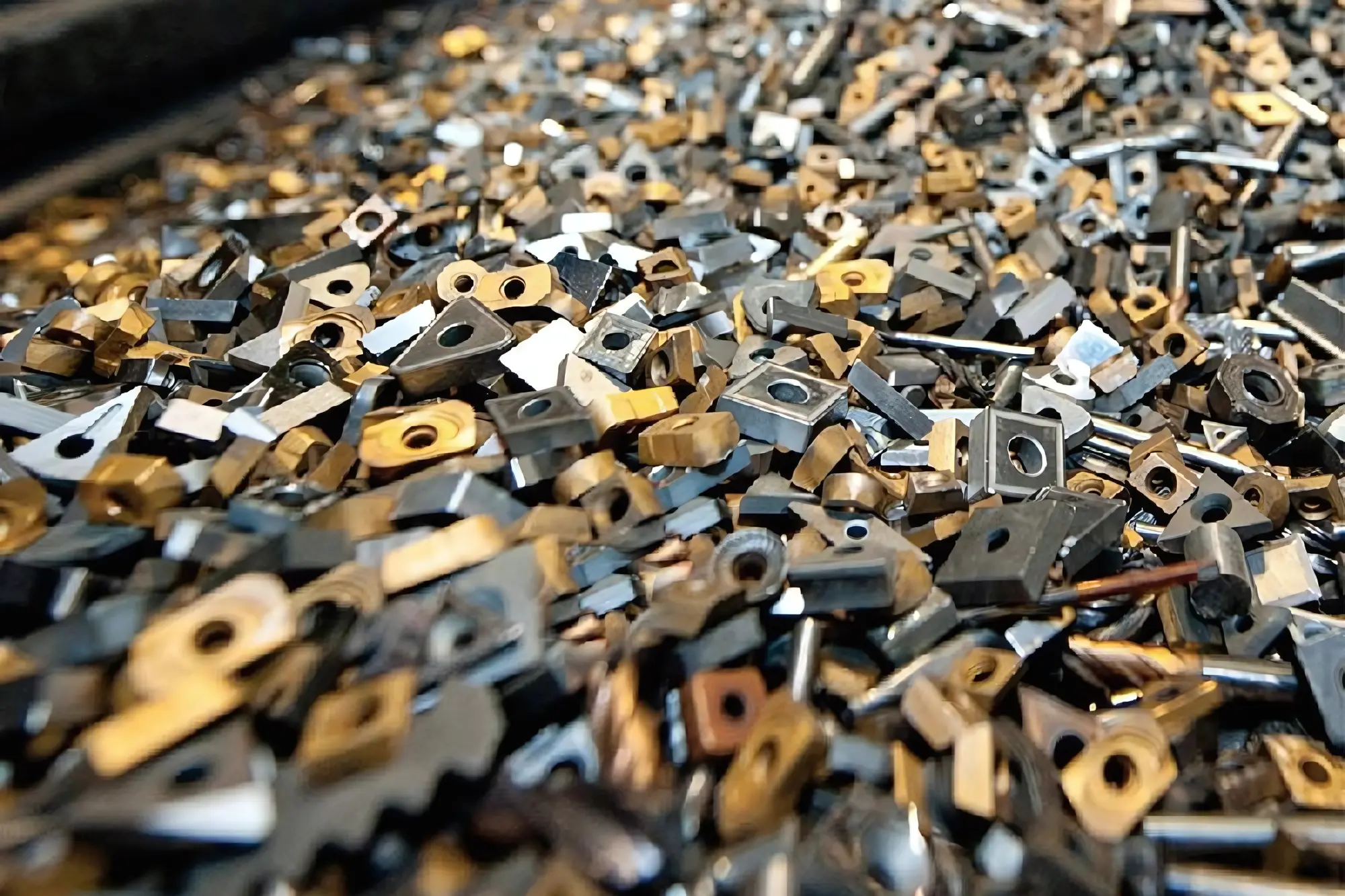
Recycling from secondary sources: We place strong emphasis on utilising secondary resources (tungsten‑bearing scrap) for recycling and reintegration into the production cycle. This approach not only reduces our dependence on primary raw materials but also represents a tangible step towards realising a circular economy and lowering our carbon footprint.
-
Preparedness for green standards: With future CBAM requirements and increasing demand for low‑carbon products, we are actively preparing to meet the needs of European and American markets.
-
Scrap buy‑back: We are ready to collaborate with customers on buy‑back schemes for tungsten‑bearing scrap, further reducing reliance on virgin materials while actively contributing to the circular economy.
Conclusion
The transition of the tungsten industry towards a circular economy is no longer a choice – it is a strategic imperative driven by EU legislation, market pressures, and the need for secure supplies of critical minerals for advanced and defence industries. With its binding target of 25 % recycling by 2030, the European Union has paved the way for substantial investment in recycling technologies +.
Industry frontrunners have already demonstrated, through their high recycling rates, that the circular economy is not only feasible but also economically viable.
By leveraging the advanced aluminothermic process, emphasising recycling from secondary sources, and maintaining production flexibility, we position ourselves as a responsible partner aligned with the green future of the ferrotungsten industry. We are ready to collaborate with companies that seek not only quality and consistency, but also sustainability and environmental responsibility throughout their supply chain.
To place an order, obtain more information, or initiate cooperation, please use the link below or contact the nickelfaravar sales team.